Blended Learning Philippines: The Practical First Step
Posted on September 1, 2026

The Practical First Step Toward Digital Transformation
Blended learning Philippines is quickly becoming the model that associations, foundations, and professional organizations are turning to as they rethink how they train. For decades, these organizations have run their seminars, certification programs, and conferences the same way: gather everyone in a room, bring in a facilitator, and deliver the training face-to-face. It has worked. Members show up, learning happens, certificates get awarded, and everyone goes home having connected with peers in the process.
But the ground is shifting. Members increasingly expect flexibility. Younger professionals are used to learning on their own schedules. And quietly, other organizations — competitors, peer associations, even entire industries — are already experimenting with online formats. Digital transformation isn’t optional anymore. The question isn’t whether to adapt, but how.
That’s where the tension sits for most training and L&D leaders: going digital feels necessary, but going fully digital feels risky. What if members resist it? What if engagement drops without a room full of people? What if the thing that made your training valuable in the first place — real, human interaction — gets lost along the way?
The good news is that organizations don’t have to choose between “all classroom” or “all online.” There’s a practical middle path, and it’s called blended learning.
Why Organizations Hesitate to Go Digital
The hesitation is real, and it deserves to be taken seriously rather than waved away with generic reassurances. When we talk to associations and training managers, the same concerns come up again and again.
There’s the fear that participants — especially senior professionals or long-time members who’ve attended the same seminar format for years — simply won’t take to online learning. There’s the practical worry about technology adoption: will people know how to log in, navigate a platform, and stay engaged without someone physically guiding them through it? There’s concern that energy and engagement will drop without a live facilitator in the room reading the crowd and adjusting on the fly.
And underneath all of it is a deeper worry: that going digital means giving up what face-to-face training does best — the networking, the real-time discussion, the credibility of an in-person certificate ceremony that participants can point to.
These fears are legitimate. But here’s the important distinction: they’re almost always fears about fully online learning — not about blending digital elements into a classroom model that’s already working. That distinction changes everything.
Blended Learning: The Practical First Step
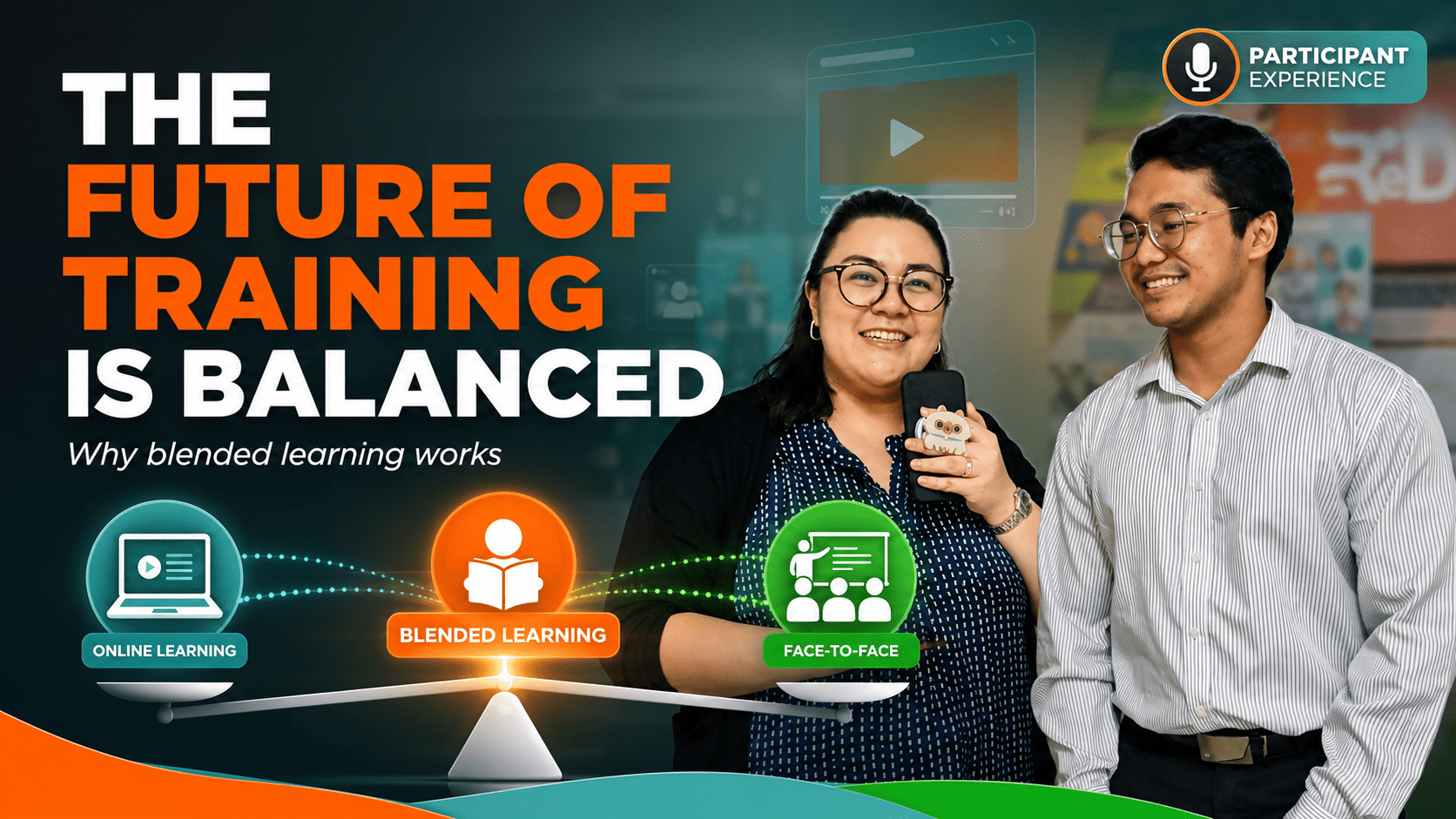
Blended learning is exactly what it sounds like: a training model where online modules and face-to-face sessions work together, each one doing what it does best.
The mechanism is simple. Online learning happens before the classroom session, giving participants a chance to build foundational knowledge at their own pace, on their own time. Then, when everyone gathers for the face-to-face portion, that classroom time is freed up for discussion, application, and interaction — instead of a facilitator spending the first hour just covering the basics.
This structure lowers the risk of going digital in a few concrete ways. Participants don’t lose the in-person experience they value; they simply arrive more prepared for it. Organizations don’t need to overhaul their entire training infrastructure overnight — a single program or certification track is enough to start. And for participants who are new to digital tools, it’s a controlled, low-pressure way to get comfortable with online learning without being thrown entirely into the deep end.
This is worth stating plainly: blended learning isn’t just a training format. It’s a change management strategy — a way to manage the people side of digital transformation, not just the technology side.
Real Participant Experience: Insights from the RBAP x Framedia Blended Learning Journey
Theory is one thing. What does this actually look like from the participant’s side?
RBAP partnered with Framedia to pilot a Blended Learning Journey, and afterward, Framedia sat down with one of the pilot’s top-performing participants to hear about his experience directly. His observations offer a grounded, first-hand look at what blended learning feels like in practice — not as a promotional claim, but as a genuine account.
For him, this was the first time he’d experienced a training that combined online learning with a face-to-face session. The online portion, he explained, functioned specifically to prepare him for the classroom day that followed — by the time he walked into the room, he already had a foundation to build on.
On the pre-training experience specifically, he noted that the information was delivered in short, digestible segments throughout — never a wall of content to get through in one sitting, but bite-sized pieces he could absorb without feeling overwhelmed or fatigued.
And when asked whether he’d recommend the format to others, his answer drew a direct comparison to the alternatives he’d experienced before: pure classroom training, which he described as intense, and pure online training, which became tedious when the content ran long. Blended learning, in his experience, struck the right balance between the two.
What makes this account useful isn’t just that it’s positive — it’s that it directly answers the exact fears associations raise in Section 2. Here is a real participant confirming that the online portion didn’t feel tedious, that the classroom portion didn’t feel diminished, and that the combination actually made the learning experience better, not riskier.
Watch the interview here – Blended learning that actually works
Benefits for Associations and Organizations
Beyond the individual learner experience, blended learning creates advantages at the organizational level:
- Better learner preparation — participants walk into the room with foundational knowledge already in place, rather than starting from zero.
- More engaging classroom sessions — facilitator time shifts away from one-way lecturing and toward discussion, Q&A, and real application of the material.
- Reduced facilitator lecture time — trainers can focus their energy on high-value interaction instead of repeating foundational content live, session after session.
- Consistent learning experience across locations — a meaningful advantage for associations with chapters or members spread across different regions.
- Easier scaling of training programs — online modules can be reused across multiple cohorts or certification runs without rebuilding content from scratch each time.
- Better use of classroom time — in-person sessions become shorter, sharper, and more valuable per hour spent, both for participants and for the organization funding the room and the facilitator.
From Blended Learning to Digital Learning
Blended learning doesn’t have to be the finish line — it’s a starting point.
Organizations that begin here can grow their digital capabilities gradually and deliberately. Start with blended learning for one program or certification track. Use participant feedback and completion data from that pilot to identify what else could reasonably move online. Over time, as both participants and facilitators build confidence and familiarity with digital tools, more content can shift into self-paced online modules.
This is where the idea of a digital learning roadmap becomes useful — a phased plan, not an overnight leap, that helps associations sequence their digital transformation in a way that brings people along instead of leaving them behind. The roadmap isn’t just a technology plan. It’s a people plan.
Conclusion
Associations and organizations don’t have to choose between staying fully classroom-based or jumping headfirst into fully online learning. Blended learning offers a practical, evidence-backed first step — one that keeps the value of face-to-face interaction intact while gradually introducing the flexibility and scalability that digital learning makes possible.
The RBAP x Framedia pilot offers a real example of this working in practice, not just in theory: a participant who found the online preparation manageable, the classroom session more meaningful because of it, and the overall balance better than either extreme.
As a Strategic Digital Learning Partner, Framedia helps organizations modernize their training at their own pace — without forcing a disruptive overhaul of programs that already work.
If you’re curious what a blended learning approach could look like for your organization’s training or certification programs, we’d be glad to walk you through it.